State Equation of a Petri Net
In a marked Petri net <N,M0>, the state equation shows how the marking of the system changes as transitions occur. It links the initial marking M0 to the current marking M through the incidence matrix C and the transition sequence σ: $$ M = M_0 + C \cdot σ $$
Understanding the Logic Behind It
Imagine a sequence of transitions σ:
$$ σ = t_{k_1}, t_{k_2}, ... , t_{k_n} $$
Each transition changes the marking of the network:
$$ M_0[σ>M_n $$
The first transition produces marking M1:
$$ M_0[t_{k_1}>M_1 $$
The second transition gives marking M2:
$$ M_1[t_{k_2}>M_2 $$
And the process continues until we reach Mn:
$$ M_{n-1}[t_{n}>M_n $$
We can express these updates step by step:
$$ M_1 = M_0 + C \cdot t_1 $$
$$ M_2 = M_1 + C \cdot t_2 \\ M_3 = M_2 + C \cdot t_3 \\ \vdots \\ M_n = M_{n-1} + C \cdot t_n $$
Adding them all together, we obtain the overall result:
$$ M_n = M_0 + \sum_{k=1}^n C \cdot t_{k} $$
This gives us the state equation of the Petri net:
$$ M_n = M_0 + C \cdot σ $$
A Practical Example
Let's take a simple Petri net with an initial marking M0, three places, and four transitions:
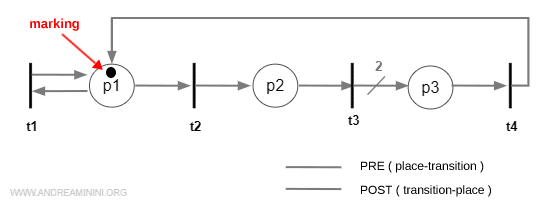
The initial marking is:
$$ M_0 = [ 1 , 0 , 0 ] $$
The incidence matrix C is obtained by subtracting the pre-incidence matrix from the post-incidence matrix:
$$ C = Post - Pre = \begin{pmatrix} 1 & 0 & 0 & 1 \\ 0 & 1 & 0 & 0 \\ 0 & 0 & 2 & 0 \end{pmatrix} - \begin{pmatrix} 1 & 1 & 0 & 0 \\ 0 & 0 & 1 & 0 \\ 0 & 0 & 0 & 1 \end{pmatrix} = \begin{pmatrix} 0 & -1 & 0 & 1 \\ 0 & 1 & -1 & 0 \\ 0 & 0 & 2 & -1 \end{pmatrix} $$
Now, let's examine a sequence of transitions:
$$ σ = t_1 t_1 t_2 t_3 $$
Here's what happens:
- Transition t1 occurs twice.
- Transitions t2 and t3 occur once each.
- Transition t4 does not occur.
So, the characteristic vector of this sequence is:
$$ σ = [ 2, 1, 1, 0 ] $$
We can now plug these values into the state equation:
$$ M = M_0 + C \cdot σ $$
Substituting the data:
$$ M = [ 1 , 0 , 0 ] + \begin{pmatrix} 0 & -1 & 0 & 1 \\ 0 & 1 & -1 & 0 \\ 0 & 0 & 2 & -1 \end{pmatrix} \cdot [ 2, 1, 1, 0 ] $$
Carrying out the row-by-column multiplication gives:
$$ M = [ 1 , 0 , 0 ] + [ -1, 0, 2 ] $$
$$ M = [ 0 , 0 , 2 ] $$
This means that after firing the sequence t1t1t2t3, the net reaches the following marking:
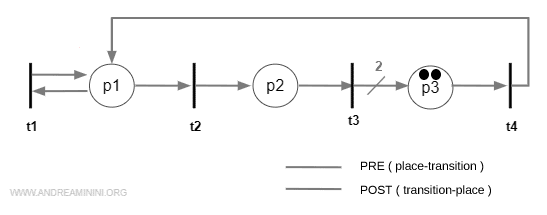
Note. In the final marking, there are two tokens in place p3 because transition t3 has two output arcs leading to it.
This simple example shows how the state equation can predict the evolution of a Petri net using linear algebra. It's a powerful way to analyze how tokens move and how the system's state changes over time.